
Hughes County Arrest Records and Court Charges
A Hughes County arrest record is the record of the arrest itself. It usually names the person arrested, the arresting agency, the date, and the booking that follows. In Hughes County, sheriff's deputies, city police, and state troopers can all make arrests. An arrest alone does not decide guilt. It only starts the process. Once a person is booked, the case moves to the District Attorney, who reviews the facts and decides what state charges to file with the court clerk. Those filed charges become the court charge record. That record lives in the District Court case file, not on a booking sheet.
The booking side is different from the charge side. Booking detail and current custody status belong with the jail and sheriff, and the closest public view of that sits in Hughes County inmate records. The court charge record shows what the prosecutor actually filed and how each count moves through the case. The full case file, including pleas, hearings, and the final outcome, is covered in Hughes County criminal court records. The arrest and the charges after arrest fill the step between booking and final judgment.
The Oklahoma Sheriffs' Association profile lists Trever Teague as the current Hughes County Sheriff, the office that books most county arrests.
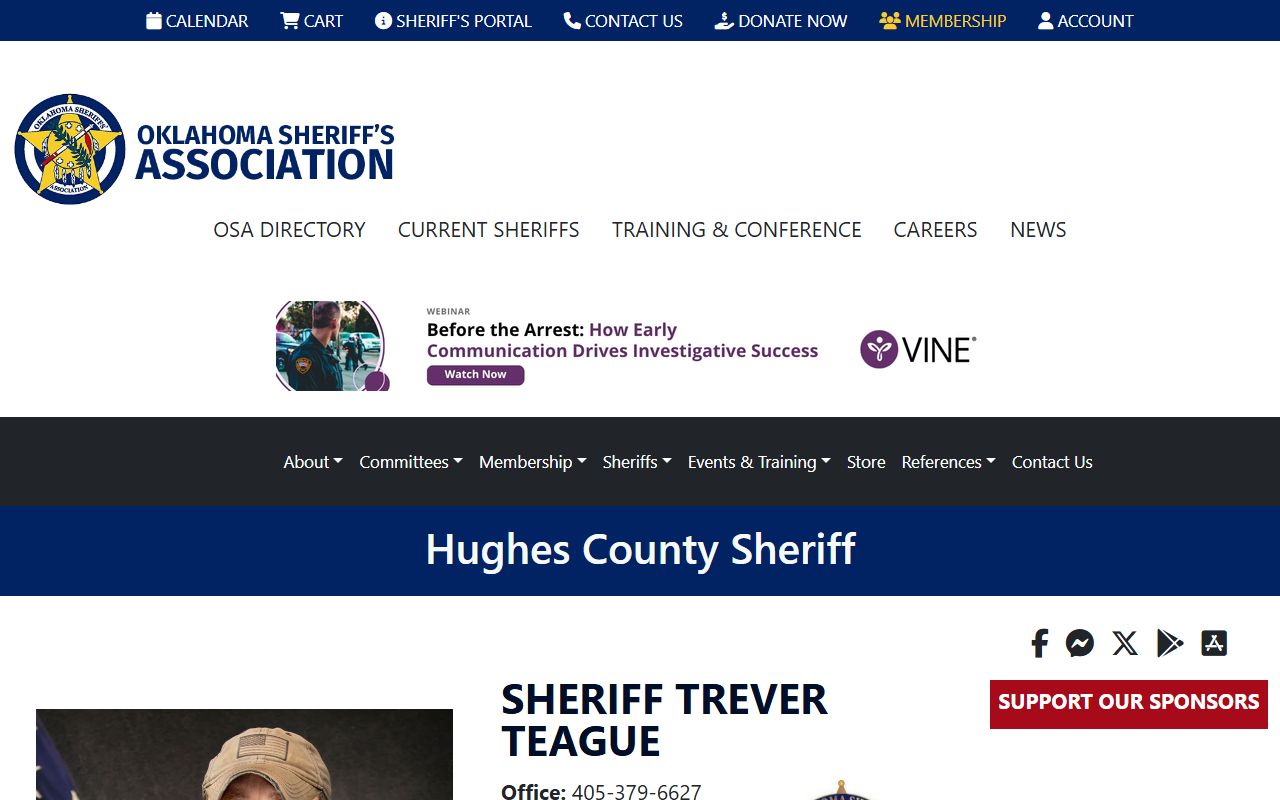
Because the sheriff's office runs the jail side, custody questions go there, while the charges that follow an arrest are filed and tracked through the District Court.
Who Files Charges After a Hughes County Arrest
The arrest and the charge are handled by different officials. A deputy or officer makes the arrest. The District Attorney files the charges. In Hughes County, that prosecutor is District Attorney Erik Johnson, who leads Oklahoma's District 22. The Hughes County DA office reviews each arrest and decides whether to file a complaint or an information, what counts to bring, and at what level. The office can also decline to file, bring fewer counts, or add counts later. This decision is the line between an arrest and a court charge.
The Oklahoma District Attorneys Council confirms that District 22 spans Hughes, Pontotoc, and Seminole counties under one elected prosecutor.
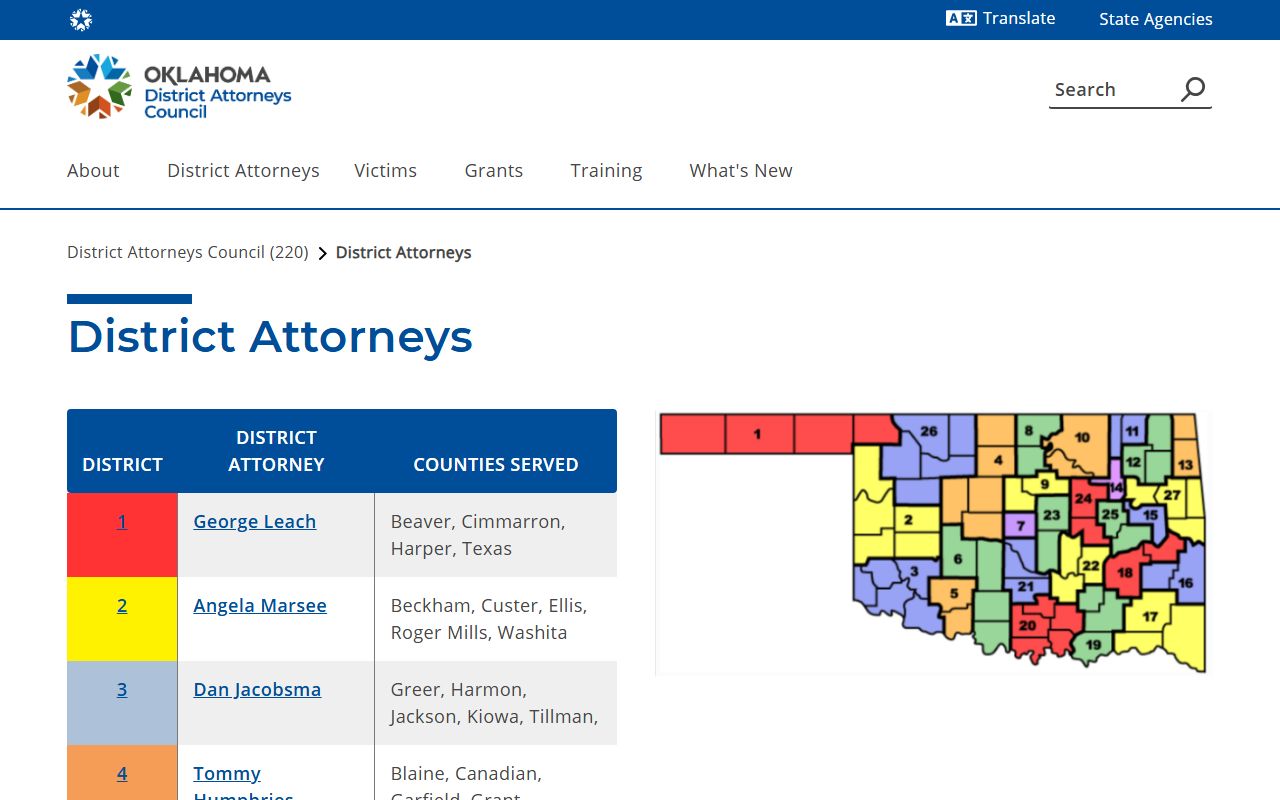
That shared structure means the same DA office that handles cases in Ada and Wewoka also files Hughes County charges. The local office sits at the courthouse in Holdenville and can be reached at (405) 379-5450. A person who cannot afford a lawyer may receive appointed counsel through the Oklahoma Indigent Defense System, since Hughes County has no separate public defender office.
How to Find Hughes County Arrest Records and Charges
Hughes County does not run its own public arrest or charge database. Filed charges appear in the statewide court systems instead. The main path is the Oklahoma State Courts Network, known as OSCN. A second path is On Demand Court Records, or ODCR. Both let the public search Hughes County District Court cases by name or case number, with basic docket viewing free of charge.
- Open the OSCN docket search and pick Hughes County District Court from the court list.
- Search by the defendant's last and first name, or enter the case number if it is known.
- Open the matching case and read the list of filed charges, shown as offense or cause entries.
- Check each charge's statute code, level, and current status in the docket.
If a case is not online, the Hughes County Court Clerk can confirm filings in person, by phone, or by mail. Court Clerk Ashley Sanford keeps the District Court files at the courthouse in Holdenville, phone (405) 379-3384. A real Hughes County case shows the format: CF-2024-00084, styled State of Oklahoma v. Cullum, listed as a criminal felony filed in October 2024. Case numbers use a prefix, a year, and a number, such as CF for felony or CM for misdemeanor.
How Hughes County Charges Are Filed: Complaint, Information, and Indictment
The charge record begins when the prosecutor files a charging document with the court. Oklahoma uses three main forms. A complaint is a sworn statement that lays out an alleged offense. An information is the prosecutor's formal charging document, and it carries most felony and misdemeanor cases in District Court. An indictment comes from a grand jury and is used for some serious felonies. Each one opens a case and sets out the counts the state must prove.
| Complaint | Information | Indictment | |
|---|---|---|---|
| Filed By | Officer / Prosecutor | Prosecutor | Grand Jury |
| Common For | Misdemeanors | Many felonies | Serious felonies |
| Starts | The case | The case | The case |
Charge Codes and Severity Levels in Oklahoma
Each charge points to a specific Oklahoma statute and carries a severity level. Felonies are the most serious and can bring prison time. Misdemeanors are lower-level offenses with lighter penalties. Some matters are handled as citations or traffic counts. One arrest can produce several separate charges, each with its own code and level. The docket lists them as numbered counts. Reading the statute citation next to a count shows exactly what law the state says was broken.
Hughes County District Court case numbers carry a prefix that signals the type of matter. The common ones include:
- CF: criminal felony case
- CM: criminal misdemeanor case
- CP: criminal probable cause filing
- TR: traffic case filed in District Court
- SW: search warrant matter
Charge Status in Hughes County Court Records
Charges do not stay frozen after they are filed. As a case moves, a count can be amended, reduced to a lower level, added, dropped, or dismissed. OSCN and ODCR dockets show these moves as status notes next to each offense or cause line. Reading the latest status matters, because an old charge may no longer reflect what the state is actually pursuing. A dismissed count is no longer being prosecuted even though it still appears in the file.
| Status | What It Means |
|---|---|
| Pending | The charge has been filed and the case is still moving toward a plea or trial. |
| Amended / Reduced | The state changed the charge, often to a lower level or a different offense. |
| Dismissed | The charge ended without a conviction on that count. |
| Nolle Prosequi | The prosecutor formally chose not to pursue the charge. |
Charges vs. Convictions in Hughes County Records
A filed charge is an accusation, not a finding of guilt. A conviction is the result of a guilty plea, a no contest plea, or a verdict. Both appear in the public court record, so a name search can turn up charges that were later dropped or that ended in acquittal. The difference is the proof. A charge needs only probable cause to be filed. A conviction needs proof beyond a reasonable doubt.
| Charge | Conviction | |
|---|---|---|
| Stage | Accusation | Verdict or plea |
| Burden of Proof | Probable cause | Beyond reasonable doubt |
| Public Record | Yes | Yes |
Statewide Charge, Criminal History, and Driver Record Lookups
Filed charges roll up into statewide systems beyond the county court file. Custody status after an arrest can be checked through Oklahoma VINE, the state's victim notification and custody search tool. Sentenced offenders held by the state appear in the Oklahoma Department of Corrections offender lookup. The state also runs a Sex and Violent Offender Registry. None of these is a county arrest blotter, but together they help fill gaps when no local roster exists.
Charges tied to driving, such as a traffic offense, also affect the state driver record. Service Oklahoma issues the official Motor Vehicle Report that shows reported convictions and license status.
The Service Oklahoma page explains how to request an Oklahoma Motor Vehicle Report, which reflects driving convictions tied to filed charges.
A driver record and a court charge record are different files, so a full picture sometimes needs both. The court file shows the charge and disposition, while the driver record shows what reached the state license history.
Sealed vs. Expunged Hughes County Records
Some charge records can be hidden or removed from public view. Oklahoma lets qualifying records be sealed or expunged through the District Court. A petition is filed under Title 22 of the Oklahoma Statutes, notice goes to the agencies that hold the records, and a judge decides. Eligibility turns on the outcome, the offense, the time since the case ended, and any prior record. A dismissed or acquitted charge is often a stronger candidate than a conviction.
| Sealed | Expunged | |
|---|---|---|
| Visibility | Hidden from public | Treated as if it never existed |
| Law Enforcement | Limited access | Very limited |
| Eligibility | Set by 22 O.S. § 18 categories | Granted by court order under 22 O.S. §§ 18 and 19 |
Municipal Charges in Holdenville and Calvin
Not every charge after an arrest goes to District Court. City police can cite people for ordinance and city traffic violations, and those municipal charges follow a separate track. In Hughes County, the Holdenville Municipal Court and the Calvin Municipal Court handle their own cases. OSCN states plainly that its District Court citation search does not search municipal citations. A city ticket may not show up in the state court system at all.
Holdenville municipal charges run through the city court, with the clerk reachable at (405) 379-6628, and Calvin holds its municipal court on a set night each month at (405) 645-2434. Anyone unsure where a charge sits should read the citation or call the issuing court. The wrong search tool will simply return nothing.
Background Check Considerations
A casual name search is not the same as a formal background check. Employers, landlords, and licensing bodies that use criminal records for decisions must follow the federal Fair Credit Reporting Act and rely on a regulated screening company. A free OSCN or ODCR search works for personal information, but it can be incomplete, can miss municipal charges, and can show charges that were later dropped. Court charge data should be confirmed against the certified file before it is relied on.
Important: This site is not a consumer reporting agency under the Fair Credit Reporting Act, and its information cannot be used for employment, tenant, credit, or other FCRA-regulated screening.
Restricted Charge Records in Hughes County
Some charge records are not open to the public. Juvenile charges are restricted under Oklahoma's juvenile code, and access is usually limited to parties, attorneys, and authorized agencies. Sealed and expunged charges drop out of public view by court order. Records tied to ongoing investigations, certain protective matters, and sensitive personal identifiers may be withheld or redacted. The Oklahoma Open Records Act treats court records as public unless a specific law makes them confidential.
For that reason, the charge picture for one person can change over time. A count can be added, reduced, dismissed, or sealed long after the first filing. The court file is the source of truth, not a screenshot or an old printout.
Note: A charge listed in an old docket may already be dismissed or sealed, so always confirm the current status with the Hughes County Court Clerk.