
How to Search Hughes County Traffic Court Records
State traffic cases filed in Hughes County District Court are searched through the Oklahoma State Courts Network, known as OSCN. The system carries District Court case data from across the state, and Hughes County District Court is one of the courts on its list. You can search by the citation number on the ticket, by a driver's name, or by case number. A second free option is On Demand Court Records, called ODCR, which views public dockets from participating Oklahoma courts.
One limit matters from the start. OSCN states plainly that its District Court citation search does not search municipal citations. A ticket written by a city officer in Holdenville or Calvin may not show up there at all. Have the citation number ready, or the driver's full name and a rough date, before you begin.
A District Court traffic search runs in a few steps.
- Open the OSCN docket search and pick Hughes County District Court from the court list.
- Choose your path: search by traffic citation, by party name, or by case number.
- Type the citation number from the ticket, or the last and first name of the driver.
- Narrow a long list with the Traffic case type or a filing-date range.
- Open a matching case to read the charge, the court date, the plea, and any balance owed.
If a case will not load or never appears, the Hughes County Court Clerk keeps the official file and can confirm whether a record exists.
Which Courts Handle Traffic Cases in Hughes County
The key split is District Court versus municipal court. A state traffic law cited by a trooper or a deputy is usually filed in Hughes County District Court, where the Court Clerk keeps the file and OSCN carries the docket. A city ordinance ticket written inside Holdenville or Calvin is a municipal matter, handled by that town's own court and clerk.
That difference decides where you search and where you pay. The three offices below cover most Hughes County traffic tickets.
Hughes County District Court
200 N. Broadway / P.O. Box 32
Holdenville, OK 74848
(405) 379-3384
State traffic citations, Court Clerk Ashley Sanford
Holdenville Municipal Court
Clerk Melissa Banai, 100 Creek Street
Court held at 209 E. Ninth Street
(405) 379-6628
City citations, court at 5:30 p.m.
Calvin Municipal Court
Clerk Linda Bennett, Judge Irby
209 Canadian Street, Calvin, OK 74531
(405) 645-2434
City citations, second Monday at 7:00 p.m.
Holdenville court is not held at the courthouse on the city's current schedule. It meets at the Grace M. Pickens Public Library, and the rules for city tickets live in Holdenville Municipal Code Chapter 38, which sets up the court, its traffic violations bureau, and bail. Calvin posts its own short schedule on the town's site.
Types of Traffic Cases in Hughes County Records
Traffic records cover a wide span, from a simple speed ticket to a charge that turns criminal. OSCN groups state traffic matters under the Traffic case type and a TR case prefix, while more serious driving crimes move to a misdemeanor or felony file. The list below shows the kinds of cases that appear.
- Moving violations - speeding, running a light or stop sign, unsafe lane changes, and following too close.
- Equipment and non-moving - faulty lights, no insurance proof, expired tag, or registration problems.
- License and paperwork - driving without a valid license or on a suspended one.
- Commercial vehicle - violations tied to a commercial driver license that the state reports separately.
- Serious driving offenses - reckless driving and similar charges that can move from traffic into a criminal file.
City tickets follow their own ordinance codes rather than state statute numbers, which is one more reason a municipal citation reads differently from a District Court traffic case.
What Hughes County Traffic Court Records Show
A traffic case file is built from a set of standard fields. The header names the case and the driver, and the docket below lists every event in date order. The same shape holds whether the record sits in District Court or a municipal court, though city files may show less online.
The table maps the common fields to what each one tells you.
| Field | What It Shows |
|---|---|
| Citation Number | The number printed on the ticket the officer issued. |
| Case Number | Court file number, such as a TR or CM prefix with a year and number. |
| Charge / Statute | The traffic law or city ordinance the driver is accused of breaking. |
| Court Date | The hearing or appearance date set by the court. |
| Plea / Disposition | Guilty, not guilty, no contest, dismissed, or the final outcome. |
| Fine and Costs | The amount owed, court costs, and any payment-plan number. |
| Warrant / FTA | Failure-to-appear or warrant entries when a date or payment is missed. |
| Payment Status | Whether the balance is open, paid, or sent to collection. |
Online dockets are a convenience copy, not the certified record. For a copy a court or agency will accept, ask the clerk who keeps the file.
Searching Hughes County Traffic Records by Citation or Name
The citation number is the fastest way in when you hold the ticket. It points to one case, so there is no guessing among drivers with the same name. The OSCN traffic-citation search reads the number printed on the ticket, and the e-payments tool accepts the same number when a balance is set up for online payment. Watch the format, since a typo in a long citation string returns nothing.
A name search helps when the ticket is lost or you are checking on someone else. It can return several matches, so a filing-date range or the Traffic case type trims the list. The fields below are the ones most used for a Hughes County traffic records search on OSCN.
| Field Label | Type | Required | Notes / Format |
|---|---|---|---|
| County or Court | Dropdown | No | Choose Hughes County District Court. |
| Citation Number | Text | No | Number on the ticket; searches District Court citations only, not municipal ones. |
| Case Number | Text | No | Traffic files use a TR prefix in a year-and-number format. |
| Last Name | Text | No | Party search by the driver's name. |
| First Name | Text | No | Party search by the driver's name. |
| Limit by Case Type | Dropdown | No | Pick Traffic to narrow a long result list. |
| Cases Filed After Date | Date | No | Example format 01/01/2010. |
Note: A name search on OSCN reaches only District Court cases, so a city ticket from Holdenville or Calvin still has to be checked with that town's municipal court.
Paying or Contesting a Hughes County Traffic Ticket
Start by reading the ticket to learn which court it names. A District Court citation is paid or fought through the state court system, while a city ticket goes to the town that wrote it. Paying admits the charge in most cases, so decide whether you want to contest before you send money.
For a state case, the OSCN e-payments page takes a case number, a citation number, or a payment-plan number where the balance is approved for online payment. To plead not guilty or ask for a hearing, contact the issuing court before the date on the ticket. The steps below cover both court types.
- Read the citation and identify whether it names the District Court or a city municipal court.
- For a District Court case, search OSCN or ODCR, then pay through OSCN e-payments by citation, case, or payment-plan number.
- For a Holdenville ticket, use the city's Pay Citations link or call Municipal Court Clerk Melissa Banai at (405) 379-6628.
- For a Calvin ticket, call the Calvin Municipal Court clerk at (405) 645-2434.
- To contest, ask the issuing court for a hearing or not-guilty setting before the appearance date.
- If a date or payment was missed, check the same court for a warrant or failure-to-appear entry and clear it promptly.
Public Access Laws for Hughes County Traffic Records
Oklahoma treats court files as public by default, and traffic cases are no exception. Records held by public bodies stay open unless a specific law makes them confidential, which keeps most traffic dockets viewable by anyone. The online docket still is not the certified file, so a court-ready copy comes from the clerk, not a screen print.
Key Statutes:
Oklahoma Open Records Act, Title 51 §§ 24A.1-24A.33 - public records of public bodies are open unless a law makes them confidential.
Title 22 §§ 18-19 - sets the path to seal or expunge qualifying records by petition and court order.
Court Traffic Records vs State Driver Records
A traffic case file and a driver record are two different things, and people often mix them up. The court file is the record of one case in one court. The state driver record, called an MVR, is the running history that Service Oklahoma and the Department of Public Safety keep for a license. Fixing one does not automatically fix the other.
| Court Traffic Record | State Driver Record (MVR) | |
|---|---|---|
| Record source | Hughes County District Court or a city municipal court | Service Oklahoma / Department of Public Safety |
| What it shows | Citation, charge, court date, plea, fine and costs, warrant or FTA entries, payment status | Driving history, convictions reported to the state, license status and suspensions, three-year summary |
| Where to access | OSCN, ODCR, or the issuing court clerk | The Service Oklahoma MVR request portal |
| How to correct errors | Contact the issuing court or clerk to fix a case entry | Resolve the underlying case first, then dispute the MVR with Service Oklahoma / DPS |
You can request a driving record through the Service Oklahoma MVR portal, which is the official path for a personal or authorized record.
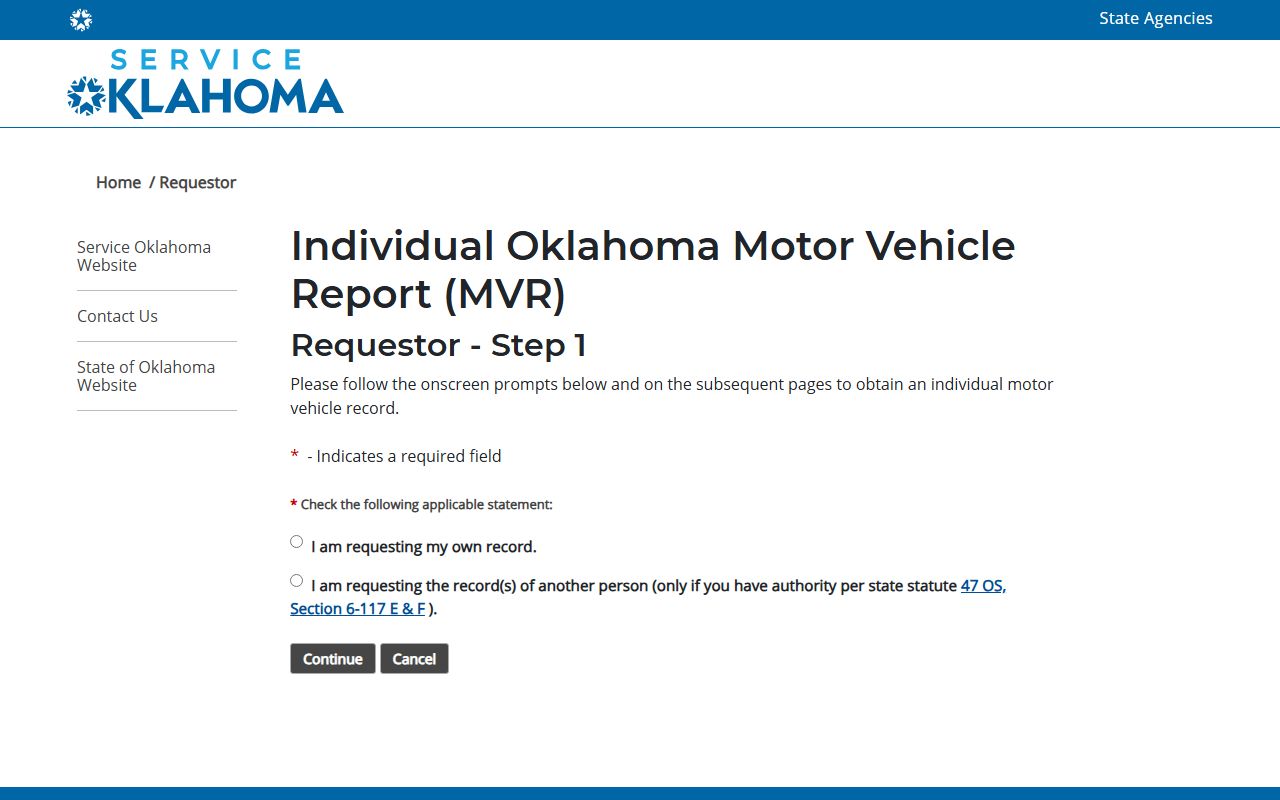
The portal first asks whose record you want, then collects the requester and driver details. The table below lists what the request walks through.
| Field Label | Type | Required | Notes / Format |
|---|---|---|---|
| Applicable statement | Radio | Yes | Your own record, or another person's record only with authority under state statute. |
| Requestor information | Text | Yes | Later pages collect requester identity and the driver's details. |
| Record type | Checkbox | Yes | Driver record / MVR; a collision record can be requested as well. |
| Payment | Online | Yes | Fees apply; the exact amount shows at checkout. |
Federal driver-privacy law limits who can pull another person's record, so the portal asks for a lawful reason before it releases a record that is not your own.
DUI and DWI Cases in Hughes County
A drunk or drugged driving charge is not an ordinary traffic ticket. In Hughes County these cases are filed as criminal matters in District Court, not handled as a simple citation. They carry the State of Oklahoma as the plaintiff, can bring jail or prison exposure, and trigger a separate license action through the state.
Because the case lives on the criminal side, the charges, pleas, and sentence appear in the Hughes County criminal court records rather than the traffic docket. The license suspension that follows shows up on the state driver record instead.
CDL and Commercial Driver Records
Commercial drivers face stricter rules, and a traffic conviction can reach further for them than for other drivers. Convictions reported to the state land on the driver record, where they can affect a commercial driver license even when the ticket itself was minor. That makes the MVR a record a commercial driver should check after any case.
Hughes County does not publish a separate commercial-driver fine list, so a CDL holder with a citation should confirm the charge and any appearance rule with the court named on the ticket and review the state driver record for what was reported.
Deferred Sentences and Defensive Driving
Some drivers want to keep a conviction off the state record. Oklahoma courts in some cases allow a deferred outcome or a driver-improvement option, which can change how a case is reported once the terms are met. The exact choices depend on the charge, the driver's history, and the court.
Hughes County and its city courts do not post a fixed program list online, so the issuing court is the place to ask what is offered. Confirm the cost, the deadline, and how completing a course or a deferred term affects both the court file and the driving record before you agree to it.
Sealing or Expunging Hughes County Traffic Records
A closed traffic case can sometimes be sealed from public view. Oklahoma allows expungement of qualifying records by petition under Title 22, Sections 18 and 19, filed in the District Court where the case happened. The petition has to name the case, the agencies that hold copies, and the basis for relief.
Eligibility is not automatic. It depends on the outcome, the offense type, the time since the case ended, and any other record, so a judge decides each request on its facts. A granted order tells the clerk and the agencies to seal or remove public access to the file.
Hughes County Crash Reports and Driver Record Copies
A wreck adds a separate document to the picture. A collision report is not a court file, and it is requested through the state rather than the court clerk. The Oklahoma DPS forms page carries the collision-report and traffic-collision materials a driver or insurer may need.
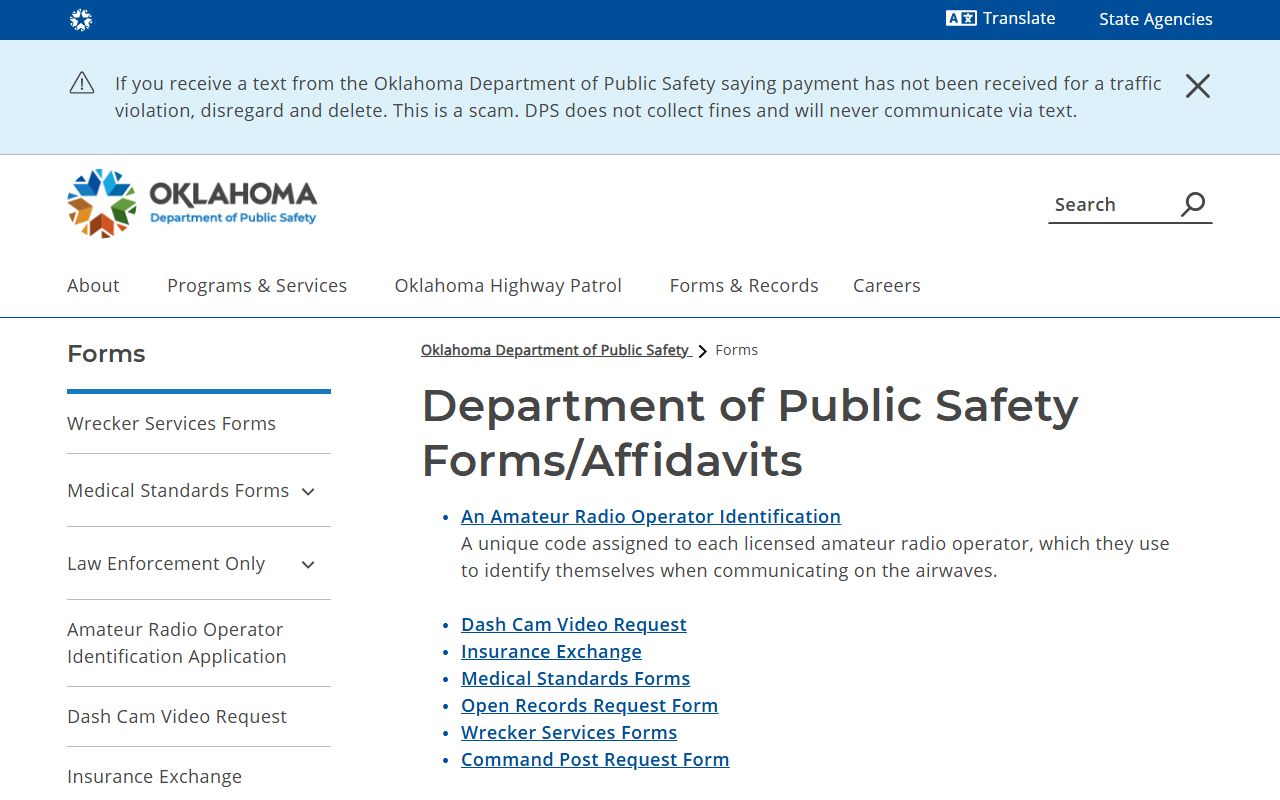
The same forms cover both the driving record summary and the crash report request. Fees apply to each, and the state lists regular and certified versions, with the online checkout showing the current charge.
Note: Hughes County traffic fine and court-copy amounts were not published in an official schedule, so confirm any fine or certified-copy fee directly with the issuing court before you pay.