
Criminal Court Records in Hughes County
A criminal court record is the case file that opens the moment the state files a charge in court. It is not the same as a booking sheet from the jail. The arrest happens first. The court case starts when a prosecutor files a written charge and the clerk gives it a case number. From that point on, the Hughes County Court Clerk keeps the file. The clerk logs every filing, every hearing, and every order until the case closes. Court Clerk Ashley Sanford runs that office at the courthouse in Holdenville.
Most criminal cases in the county are heard in the Hughes County District Court, the trial court of general jurisdiction. It handles both felony and misdemeanor matters. A felony is a serious crime that can bring prison time. A misdemeanor is a lower-level offense. City ordinance and city traffic cases are different. Those may go to a municipal court, such as the Holdenville or Calvin municipal court, and they do not show up in the state district court case search. The arrest side of the story and the charges as filed are covered in more depth on the Hughes County arrest and charge records page.
How to Search Hughes County Criminal Court Records
The main place to look up a Hughes County criminal case is the Oklahoma State Courts Network, known as OSCN. It lets you pick Hughes County District Court and then search by case number, party name, case type, or filing date. A second free option is On Demand Court Records, or ODCR, which shows public docket data for many Oklahoma courts. Both are free to search and view.
- Open the OSCN docket search and set the court to Hughes County District Court.
- Search by the defendant last and first name, or type the case number if you have it.
- Narrow the results with case type, such as Criminal Felony or Criminal Misdemeanor, and a filing date range.
- Open the case to read the docket, the charges, and the disposition.
- Ask the Court Clerk for a certified copy when you need an official version.
Online dockets are useful, but they are not the official file. Some OSCN pages are blocked by an anti-bot check, and sealed items never show at all. When a case will not load or a document is missing, the fallback is the Court Clerk at (405) 379-3384, or a written request mailed to P.O. Box 32, Holdenville, OK 74848. Court costs and fines on an eligible case can be paid through OSCN e-Payments by case number, citation number, or payment plan number.
Stages of a Criminal Case in Hughes County
A criminal case moves through a set order of steps, and each step leaves a mark in the file. The docket grows as the case goes on. Reading the docket in order is the best way to see where a case stands and how it ended. The flow below shows the path a typical felony or misdemeanor takes in the Hughes County District Court.
Case flow: Charges Filed › Arraignment › Pretrial / Motions › Plea or Trial › Disposition › Sentencing
| Stage | What Happens |
|---|---|
| Charges Filed | The district attorney files a complaint or information. The clerk opens a case and assigns a number. |
| Arraignment | The court tells the defendant the charges. The defendant enters a plea of guilty, not guilty, or no contest. |
| Pretrial / Motions | Lawyers file motions, share evidence, and set hearings. Bond and court dates appear here. |
| Plea or Trial | The case ends in a plea deal, or a judge or jury hears the trial and reaches a verdict. |
| Disposition | The record shows the result: convicted, dismissed, acquitted, or deferred. |
| Sentencing | After a conviction the judge sets the penalty, such as prison, jail, probation, fines, or costs. |
Note: A docket can also show a warrant or a motion to revoke probation, which means the case reopened after the first disposition.
What a Hughes County Criminal Court Record Shows
A criminal case file is built from many small fields. Once you know what each one means, the record reads like a story from charge to outcome. The table below lists the core fields seen in a Hughes County District Court criminal case, drawn from real OSCN and ODCR samples. Case numbers in the county use a prefix, a year, and a number, such as CF-2024-00084 for a felony.
| Field | What It Shows |
|---|---|
| Case Number | The court ID, such as CF for felony or CM for misdemeanor, plus the year and a count. |
| Style | The case name, written as State of Oklahoma v. the defendant. |
| Defendant | The person charged, with sensitive data like the full Social Security number masked. |
| Charges | Each offense or cause, often numbered by count, with the code and a short description. |
| Plea | The defendant's response: guilty, not guilty, or no contest. |
| Docket Entries | Filings, motions, minutes, subpoenas, hearings, and orders, listed by date. |
| Disposition | The outcome of each charge, such as convicted, dismissed, or deferred. |
| Sentence | The penalty after a conviction, plus fines, costs, and any bond or payment plan. |
How the District Attorney Files Charges in Hughes County
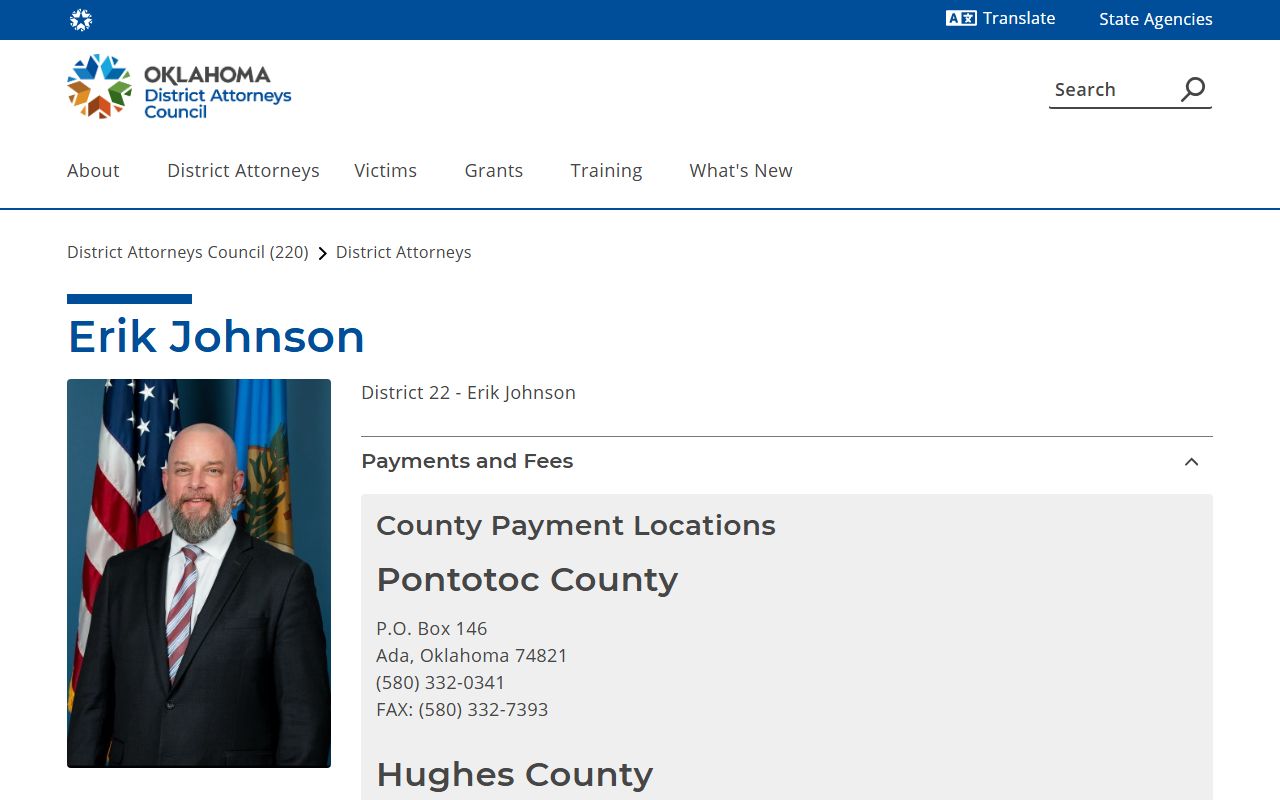
An arrest does not start a court case on its own. The district attorney decides what charges, if any, to file. Hughes County sits in District 22, led by District Attorney Erik Johnson. The same district covers Pontotoc and Seminole counties. The DA reviews the police report, then files a complaint or information that lists each count. That charging document is what opens the criminal court record and sets the case in motion.
You can confirm the local prosecutor and office contact on the Oklahoma District Attorney District 22 page, which lists the Hughes County office in Holdenville.
The DA also handles plea talks, victim services, and restitution, all of which can appear as docket entries. A defendant who cannot afford a lawyer may receive appointed counsel. In counties without a local public defender office, that work runs through the Oklahoma Indigent Defense System. The court, not this office, decides who qualifies. The exact list of counts and how a charge can change over time is covered on the Hughes County court records page.
Charges vs. Convictions
Being charged is not the same as being found guilty. A criminal court record often shows charges that were later dropped, dismissed, or that ended in an acquittal. A charge is only an accusation. A conviction is a final finding of guilt by plea or verdict. The two carry very different weight, so read the disposition before you draw any conclusion from a file.
| Charge | Conviction | |
|---|---|---|
| Stage | Accusation by the state | Verdict or plea of guilt |
| Burden of Proof | Probable cause | Beyond a reasonable doubt |
| Can It Change | Yes, it can be reduced or dropped | Final unless appealed or vacated |
| Public Record | Yes | Yes |
Reading Dispositions and Sentences
The disposition is the heart of any criminal court file. It tells you how a charge ended. A guilty plea or guilty verdict leads to a conviction. A not guilty verdict is an acquittal. A dismissed charge ends with no finding of guilt. A no contest, or nolo, plea is not an admission of guilt but lets the court treat the case much like a guilty plea. A deferred case puts off a final judgment while the defendant meets set terms.
After a conviction, the sentence sets the penalty. A sentence can mean time in prison, time in jail, probation, fines, court costs, or a mix of these. Some files also show a payment plan number when costs are paid over time. Read each count on its own, since one case can hold several charges with different results.
Court Cases vs. Jail Custody in Hughes County
A court case and a person's custody status are two separate things. The court file tells you about charges and outcomes. It does not tell you, in real time, whether someone is locked up. Hughes County does not publish a verified official online jail roster, and news reports have raised concerns about the local jail. So custody questions need a different tool.
The best public option for custody status is Oklahoma VINE, the statewide search and notification system. For someone serving a state prison term, use the Oklahoma Department of Corrections offender lookup. DOC warns that its data is brief and not a full account of the offense or sentence. If a warrant is the real concern, check the issuing court's docket on OSCN or call the Court Clerk to confirm whether one appears in the case file.
Note: VINE and DOC track people, not cases, so use the court search for charges and these tools for where a person is held.
Sealed vs. Expunged Criminal Records
Some criminal records are removed from public view. Oklahoma uses two main routes, and they are not the same. A sealed record is hidden from the public but may still be reached by limited parties under the law. An expunged record is treated, for most purposes, as if it never existed. A person seeks an expungement by filing a petition in the District Court where the case happened.
| Sealed | Expunged | |
|---|---|---|
| Visibility | Hidden from public view | Treated as if it never existed |
| Law Enforcement | Limited access remains | Very limited access |
| Process | Court order on a stated basis | Petition and court order |
| Eligibility | Depends on the case and the statute | Depends on outcome, offense, time, and prior record |
The expungement path is set out in 22 O.S. §§ 18 and 19. The petitioner cites the qualifying category, gives notice to the agencies that hold records, and asks the judge for an order. If the court grants it, clerks and agencies seal or remove public access. Eligibility is never automatic, since it turns on the case outcome, the type of offense, the time that has passed, and any prior record.
Public Access to Hughes County Criminal Court Records
Oklahoma treats most court records as open to the public. Criminal case files are public unless a statute or a court order makes them confidential. That open rule is what lets anyone search a Hughes County criminal case by name. Still, the online docket is not the same as the certified court file, and only the Court Clerk can give you an official copy.
Key Statutes:
Oklahoma Open Records Act, 51 O.S. §§ 24A.1-24A.33 - Records held by public bodies are open unless a law makes them confidential.
51 O.S. § 24A.30 - Court records are public unless another statute makes them confidential, and sealing needs a court-specific basis.
Important: A screenshot from OSCN or ODCR is not a certified record, so a court or agency may reject it in place of an official Court Clerk copy.
Restricted Hughes County Criminal Court Records
Not every criminal matter is open. Several kinds of records are held back to protect people or to follow the law. When a file is restricted, the public search may show nothing, show only a redacted version, or require a court order before release.
- Juvenile cases, which are confidential under Title 10A and open mainly to parties and authorized agencies.
- Sealed and expunged cases, which stay out of public view after a court order.
- Adoption files, which are not handled like ordinary public case records.
- Mental health commitment and treatment records, which are confidential under state law.
- Personal identifiers, such as Social Security numbers, financial account data, and the names of minors.
For anything that does not show online, the Hughes County Court Clerk is the office to call. Court records, criminal filings, and certified copies all route through that counter at the courthouse on North Broadway in Holdenville.